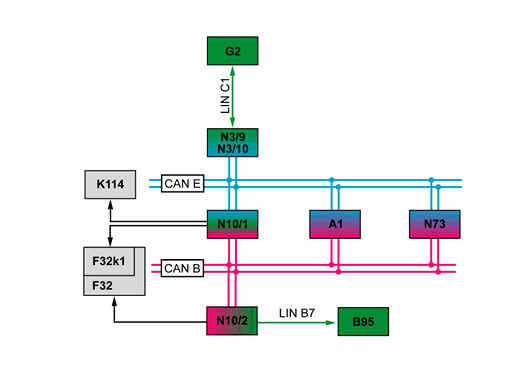
GF54.10-P-0003RD

Energy management, function

23.2.12

MODEL  172.4


A1 Instrument cluster
B95 Battery sensor
F32 Front prefuse
F32k1 Decoupling relay
(with code (B03) ECO start/stop function)

G2 Generator
K114 ECO start/stop function additional battery relay (with code (B03) ECO start/stop function)
N3/9 CDI control unit (with diesel engine)
N3/10 ME-SFI [ME] control unit (with gasoline engine)
 
    P54.10-3627-76

N10/1 Front SAM control unit with fuse and relay module
N10/2 Rear SAM control unit with fuse and relay module
N73 Electronic ignition switch control unit


----------------------------------------------------------------------------------------
  CAN B Interior CAN
CAN E Chassis CAN

LIN B7 On-board electrical system LIN
LIN C1 Drive train LIN
----------------------------------------------------------------------------------------

Function requirements, general
• Circuit 30 ON

Energy management, general
Energy management manages the provision (supply) and consumption (management) of electrical energy with the aim of ensuring the startability of the engine and a stable supply to all electrical consumers.

The following components are involved in energy management:
- Battery sensor
(monitoring of on-board electrical system battery charge level (G1))
- On-board electrical system battery
(power storage and supply when the engine is off)
- Additional battery for ECO start/stop function (G1/13)
(with code (B03) ECO start/stop function)
(on-board electrical system-power supply with automatic engine start)

----------------------------------------------------------------------------------------
  - Alternator (energy generation)
- CDI control unit (on diesel engine) or
ME-SFI [ME] control unit (on gasoline engine) (alternator management)
- Front SAM control unit (actuation of on-board power supply management support)
(with code (B03) ECO start/stop function)
- Rear SAM control unit (On board power supply management, master control unit for energy management)

Energy management consists of the following subsystems:
On-board electrical system management
Major assemblies coordinator

On-board electrical system management
The on-board electrical system management monitors on-board power supply utilization and actively intervenes in the energy management (e.g. through consumer shutoff). The aim is to ensure the starting ability of the engine and a stable power supply to all electrical consumers.
----------------------------------------------------------------------------------------

Transport mode (as of 1.6.12):
The transport mode is activated in the production plant at the end of the production process, and it sets the overall vehicle into a defined special condition.

With targeted interventions in individual electronics systems the following is achieved:
- Reduction of shipping damage and accidents
- Best-possible charging of on-board electrical system battery through optimized energy management
- Avoidance of any damage and soiling of the interior as well as theft of loose parts from the interior
- Discontinuation of transport protection seal

The transport mode remains active on its way from the production plant to the dealers and company-owned sales and service outlets around the world up to the so-called delivery inspection and the final handover to the end customers.


-----------------------------------------------------------------------------------------
  \"mblogo\" The transport mode is automatically deactivated from a total distance traveled of more than 350 km whereupon it cannot be activated again. Up to this limit, the transport mode can be deactivated using the diagnosis tester or key combinations at any give time and activated with the diagnosis tester again.
The fault memory is not actively deleted when the key combination is used for deactivation. This means that the "Transport mode active" fault entry remains stored. This must be deleted using the diagnosis tester when the vehicle is inspected for the first time.

To support the processes in Sales and Logistics the vehicle's currently possible residual service life and, if necessary, appropriate care instructions for the on-board electrical system battery are shown on the instrument cluster when the transport mode is active.
The on-board electrical system management's continuously determined condition of the on-board electrical system battery is rendered fully transparent at any given time without the use of any additional measuring instruments during the vehicle delivery period.
-----------------------------------------------------------------------------------------

This display provides the operating personnel with specific instructions on what to do to guarantee a high delivery quality with regard to the on-board electrical system battery.

The individual transport mode functionalities are split up for numerous individual systems. The core here is the central control of the transport mode by the on-board electrical system management.
In keeping with the specifications of the on-board electrical system management, targeted interventions are made (function limits or modifications) in individual electronic systems.


-----------------------------------------------------------------------------------------
  The following function limits or modifications are implemented during the transport mode:
- Limitation of vehicle speed to 40 km/h
- Electric locking of front passenger door and trunk lid
- Open Vario roof function locked
- Monitoring of circuit 15 at standstill and acoustic feedback, when the vehicle is at a standstill for t > 10 s with the ignition switched on and the engine switched off
- Optimized quiescent current management, when the vehicle is parked for an extended period (e.g. transportation by ship )
- Limit exterior light functions
- Implement display on instrument cluster
- Adjust fault memory handling
-----------------------------------------------------------------------------------------

The following tasks are implemented by the on-board electrical system management:
- Set specific consumer shutoff stages
- Optimized charging of on-board electrical system battery:
- Activate fast battery charging
- Deactivate alternator management
- Deactivation of engine start/stop function
(With code (B03) ECO start/stop function)
- Early opening of no-load current shutoff relay (F32k2)
- Restriction of closing reasons for quiescent current shutoff relay


-----------------------------------------------------------------------------------------
  Major assemblies coordinator
The major assembly coordinator is integrated into the CDI control unit or the ME-SFI [ME] control unit and forms the interface between the on-board electrical system management and the alternator. The CDI control unit or the ME-SFI [ME] control unit communicates with the alternator over the drivetrain LIN. The major assembly coordinator regulates the alternator's power output to match the on-board electrical system management specifications taking engine load into consideration.

The recording and evaluation of the relevant variables for this are conducted by the following components:
- Rear SAM control unit
- CDI control unit or ME-SFI [ME] control unit
- Generator
-----------------------------------------------------------------------------------------

Energy management contains the following subfunctions, which are described in separate documents:
Engine on energy management, function
Engine off energy management, function
Energy management for engine start/stop function
(with code (B03) ECO start/stop function)
  \"mblogo\" The "energy management for engine start/stop function" subfunction is viewed from an energy management point-of-view. Information on the "engine timing Start-Stop function" subfunction is contained in the "Common-Rail Diesel Injection (CDI) function" description (with diesel engine) or "gasoline injection and ignition system with direct-injection function" (with gasoline engine).


Engine on energy management, function


Engine off energy management, function


Energy management for engine start/stop function

With code (B03) ECO Start-stop function