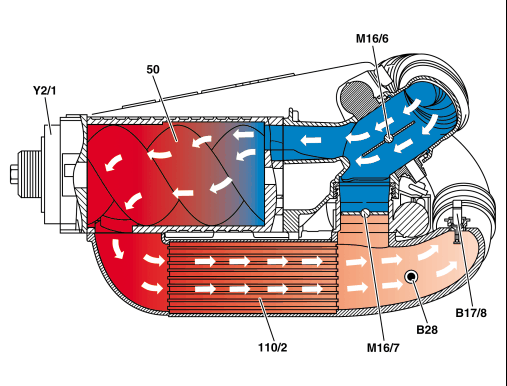
Compressor actuated
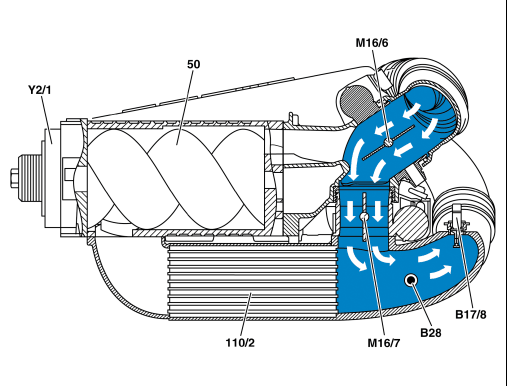
50 Compressor
110/2 Charge air cooler
B17/8 Charge air temperature sensor
B28 Pressure sensor (charge air)
M16/6 Throttle valve actuator
M16/7 Recirculated air flap actuator
Y2/1 Mechanical supercharger magnetic clutch
| GF09.00-P-2000AM | Turbocharging - function | 9.10.02 |
| |||||
| Recirculated air flap closed,
Compressor actuated 50 Compressor 110/2 Charge air cooler B17/8 Charge air temperature sensor B28 Pressure sensor (charge air) M16/6 Throttle valve actuator M16/7 Recirculated air flap actuator Y2/1 Mechanical supercharger magnetic clutch |
| |
| P09.00-2035-76 |
| Recirculated air flap open,
Compressor not actuated 50 Compressor 110/2 Charge air cooler B17/8 Charge air temperature sensor B28 Pressure sensor (charge air) M16/6 Throttle valve actuator M16/7 Recirculated air flap actuator Y2/1 Mechanical supercharger magnetic clutch |
 | |
| P09.00-2033-76 |
| Charging increases the performance of the engine in the upper partial loading and full loading ranges.
The compressor (50) compresses the intake air and therefore increases the degree of filling of the cylinder. The metered fuel quantity is increased as a result of the rise in the air quantity. This increases the torque produced and the engine output. The charge air cooler (110/2) lowers the charge air temperature and thus improves the degree of filling of the cylinder. This increases engine output, reduces fuel consumption and lowers the exhaust gas temperature. A lower exhaust gas temperature means that the NOx-emission is lowered. Function The drive power needed to drive the compressor is taken from the crankshaft over a separate belt drive. The magnetic coupling of the mechanical supercharger (Y2/1) is responsible for switching the compressor on and off. The magnetic clutch is actuated map-controlled by the ME-SFI [ME] control unit (N3/10) if a high engine torque is requested. The compressor is always actuated for technical reasons from an engine speed of about 3500 rpm. |
The charge air pressure is regulated over the recirculated air flap actuator (M16/7) which is controlled directly according to the performance map by the ME control unit. If the compressor is switched off the intake air can by-pass over the air recirculation flap on the compressor. The air can be directly suctioned in this way without the compressor having to turn with it. This means that the fuel consumption is reduced during idling and in the partial loading range.
The opening angle of the recirculated air flap changes in the opposite direction to the opening angle of the throttle valve. What this means is: if the throttle valve is opened, for example by 20°, then the air recirculation flap closes 20°. The recirculated air flap is completely closed at full load (maximum charge pressure) while the throttle valve is wide open (maximum intake air). The charge air temperature and the charge air pressure are measured in the charge air distributor and sent to the ME control unit in order to allow adjustment of the correct fuel quantity for the degree of filling of the cylinder. 
The compressor is switched on shortly when starting with external temperatures below 0°C in order to free up the compressor from any icing which may have occurred (through the presence of condensate in the compressor). |
| Pressure sensor - location/task/design/function | GF07.04-P-5014AM | ||
| Charge air temperature sensor - location/task/design/function | GF07.04-P-5039AM | ||
| Charge air cooler
Location/task/design/function |
GF09.41-P-3100AM | ||
| Recirculated air flap actuator
Location/task/design/function |
GF09.50-P-3101AM | ||
| Compressor
Location/task/design/function |
GF09.50-P-3102AM | ||
| Magnetic clutch for the mechanical supercharger - location/task/design/function | GF09.50-P-3103AM | ||
| Throttle valve actuator - location/task/design/function | GF30.22-P-4101AM |